Wednesday, 17 January 2024
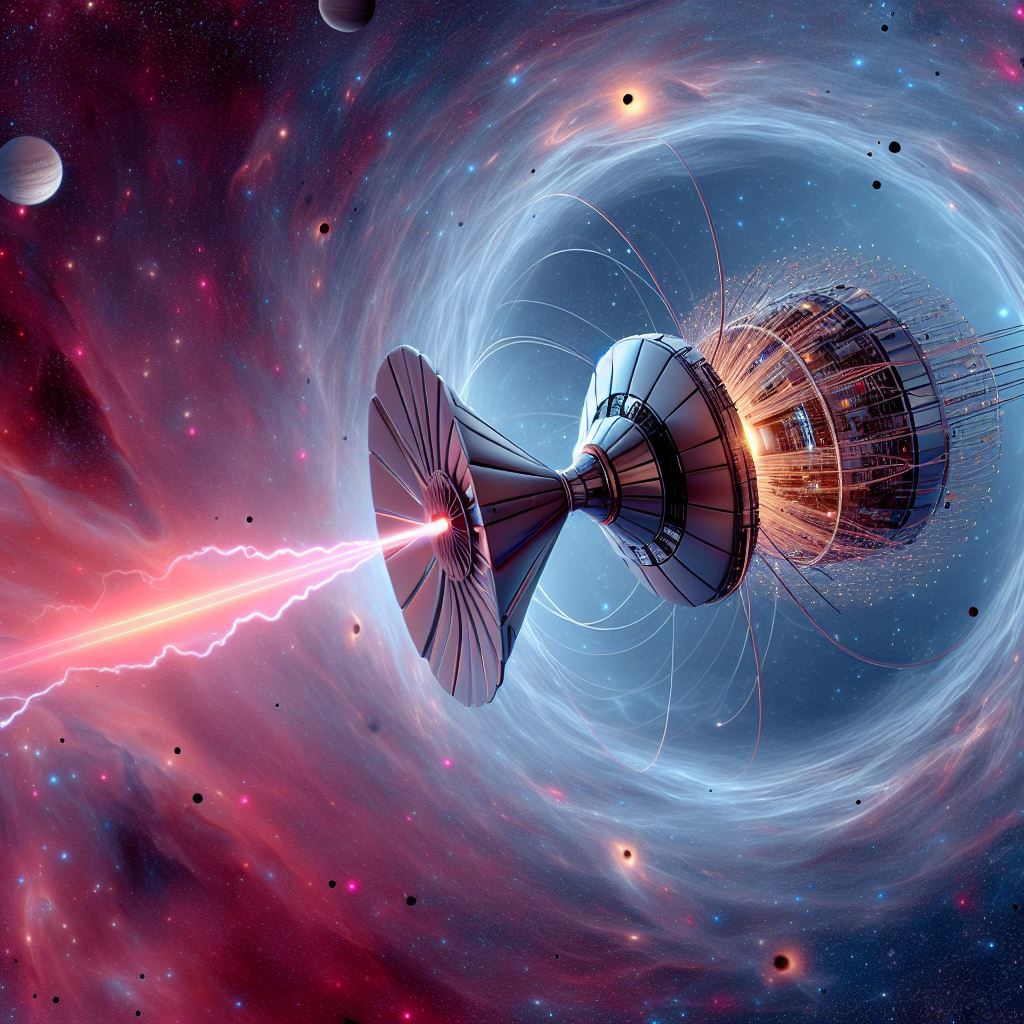
Hypothesis for Further Investigation: Using the Wilkinson Microwave Anisotropy Probe (WMAP) for Space Navigation around Black Holes and Stars
Hypothesis for Further Investigation: Mass-Dependent Speed of Light and its Implications
Hypothesis: Sex Determination by Early Hormonal Priming in Mammals
Tuesday, 16 January 2024
Hypothesis for Further Investigation: The Implications of a Modified Planck's Equation with Inclusion of c²
Abstract:
The iconic Planck's equation (E = hv) elegantly relates the energy (E) of a photon to its frequency (v) through Planck's constant (h). While this equation has served as a cornerstone of modern physics, introducing the speed of light squared (c²) as a multiplicative factor (E = hvc²) presents a potentially groundbreaking avenue for further investigation. This hypothesis delves into the physical consequences and theoretical implications of such a modified Planck's equation, paving the way for intriguing possibilities in diverse fields like quantum gravity, dark matter, and black hole physics.
1. Motivation:
Including c² in Planck's equation raises intriguing questions about the nature of light and its interaction with spacetime. This modification resonates with existing ideas in special and general relativity, where c² represents the conversion factor between mass and energy and the curvature of spacetime due to gravitation, respectively.
2. Potential Consequences:
Modified Photon Energy and Mass: The proposed equation suggests a dependence of photon energy on c², implying a potential non-zero rest mass for photons. While current evidence contradicts this, it warrants further theoretical exploration in the context of quantum gravity, where spacetime fluctuations might endow photons with virtual mass.
Spacetime Coupling and Dark Matter: The inclusion of c² could indicate a deeper coupling between light and spacetime. This interaction might manifest in the form of exotic particles or fields that contribute to the observed effects of dark matter. This hypothesis could lead to novel approaches for dark matter detection and understanding.
Black Hole Thermodynamics and Information Paradox: Black hole thermodynamics posits an upper limit on the entropy a black hole can radiate. Incorporating c² in Planck's equation might alter this limit and offer insights into the black hole information paradox, potentially suggesting solutions for preserving information during Hawking radiation.
3. Experimental and Theoretical Verification:
High-energy photon experiments: Testing the hypothesis would require high-precision measurements of photon energy and momentum at extreme energy scales. Deviations from standard Planck's equation could provide evidence for the modified form.
Development of a unified quantum gravity theory: Integrating the modified Planck's equation into a consistent quantum gravity framework would be crucial for validating the hypothesis and its implications. This would involve reconciling quantum mechanics with general relativity, a long-standing challenge in theoretical physics.
4. Conclusion:
Introducing c² into Planck's equation offers a thought-provoking hypothesis with potentially transformative implications across various fields of physics. While experimental and theoretical verification remain significant challenges, the pursuit of this hypothesis could lead to groundbreaking discoveries about the nature of light, spacetime, and the universe's deepest mysteries.
Note: This hypothesis is highly speculative and requires further rigorous investigation. It should not be interpreted as a definitive statement on the validity of including c² in Planck's equation. The aim is to encourage further research and exploration of this intriguing possibility.
Disclaimer: Google's Artifical Intelligence has been used to generate this paper using all the information available to it in its model.
The Relative Speed of Light and the Influence of Gravity: A Hypothesis for Further Investigation
Abstract: The widely accepted notion of light's constant speed (c) throughout the universe has been a cornerstone of physics since Einstein's theories of relativity. However, this hypothesis relies heavily on measurements conducted within the gravity-influenced environment of our solar system. This paper proposes a theoretical framework suggesting that light's speed might not be absolute, but rather relative to the gravitational potential it experiences. This hypothesis challenges the current paradigm and warrants further investigation through experimentation and theoretical refinement.
1. Introduction:
The speed of light (c) is often referred to as a universal constant, a cornerstone of our understanding of the universe. However, this notion relies primarily on measurements conducted within our solar system, which is inherently subject to the influence of the sun's gravity.
2. The Influence of Gravity on Spacetime:
General relativity posits that gravity is not a force, but rather a curvature of spacetime caused by mass and energy. This curvature affects the paths of all objects moving within its influence, including light. Consequently, the speed of light might be influenced by the strength of the gravitational potential it experiences.
3. Hypothesis:
We propose that the speed of light is not a universal constant, but rather a variable dependent on the gravitational potential it encounters. In regions with stronger gravity, light's speed might decrease compared to its value in weaker gravitational fields, such as interstellar space. This hypothesis proposes a scenario where c = c(φ), where c is the speed of light and φ is the gravitational potential.
4. Supporting Arguments:
Gravitational lensing: The observed bending of light by massive objects like galaxies suggests that gravity interacts with light, potentially affecting its speed.
Gravitational redshift: The observed redshift of light emitted from objects in strong gravitational fields could be explained by a decrease in the speed of light relative to the observer.
Black holes and the event horizon: The escape velocity at the event horizon of a black hole is c. If light's speed were not affected by gravity, even photons would not be able to escape.
5. Consequences and Implications:
If the hypothesis is true, it would have profound implications for our understanding of the universe:
Cosmological models: Current cosmological models rely on a constant c. A variable speed of light would necessitate revisions to understand expansion, dark energy, and the cosmic microwave background radiation.
Black hole physics: The behavior of black holes and the event horizon would need to be re-evaluated in the context of a non-constant c.
Gravitational wave propagation: The speed of gravitational waves might also be tied to the local gravitational potential, with implications for gravitational wave detection and interpretation.
6. Conclusion:
The hypothesis of a relative speed of light, while currently speculative, warrants further investigation. New experiments and theoretical frameworks could shed light on this fundamental question. Exploring the possibility of a variable c would not only challenge our current understanding of gravity and light, but also open doors to new avenues in cosmology, black hole physics, and the nature of spacetime itself.
Note: This paper is intended to be a starting point for discussion and further research. It acknowledges the limitations of our current understanding and emphasizes the need for rigorous experimentation and theoretical refinement. It is not a definitive proof of a variable speed of light, but rather a call to explore the possibility and its potential consequences for our understanding of the universe.
Disclaimer: The hypothesis presented here is currently not widely accepted in the scientific community. More research and evidence are needed to substantiate its validity (e.g. measuring speed of light in the same conditions as we currently have measured it within our solar system/galaxy). This paper is intended as a thought experiment to stimulate further discussion and investigation. Moreover, Google's Artifical Intelligence has been used to generate this paper using all the information available to it in its model.
Tuesday, 7 April 2020
Switching to the NBN - Fibre To The Node (FTTN) - what you want to know that no one seems to tell you
- What is FTTN?
- Can I use my existing modem?
- Which provider should I choose?
- What plan should I choose?
- Will my existing home phone still work?
Tuesday, 28 January 2020
Making an Automatic Sliding Gate
Sliding gates can be quite useful for closing in your yard. In my case a garage door would have cost about the same however limited the usable space. After looking around many places offer prefabricated gates however they seemed a bit more expensive or you would have to pick up the whole gate once it has been made. Given my gate was 4.5 meters wide and 1.5 meters high, I would have had to likely hire a truck and drive a fair distance. Not to mention the gate would have been custom made since i couldnt find anyone who reasonably flat packed that size. Though this may be a viable option for yourself if you want to save on time, effort and to get the desired finish.
After some research I thought i may be able to pull this off. As a general handy kind of person but not too much experience in cutting, welding and general construction - it seemed like a reasonable project to try and tackle.
PLANNING
These are the guides (Jackal Fencing | EasyGate | BMGI | AutomaticGateSolutions ) I read which were very handy on the do's and dont's for sliding gate consutruction and installation. Its recommended to have a read if you're looking to make a start. It definitely helped in preparing for what would be required for the construction and installation.CONSTRUCTION
After measuring up the following was aquired to make the frame and support posts from a local metal supplier. I found Scott's Metals quite handy for finding metal products and prices for estimation. Atleast when you go into your local supplier you vaguely sound like you know what you're talking about.
- 100x100x2 SHS Galvanised steel (2x2.2m)
- 50x50x2 - SHS Galvanised steel (1x4.5 and 2x1.58m)
- 100x50x2 RHS Galvanised steel (1 x 4.5m)
- 25x25x3 angle - (2 x 4.4m)
The slats came down to a choice of Merbau decking or hardwood fence. The total coverage including spacing was 6.732m2. I gave the hardwood fence a go and just sanded it back and clear varnished it. I figure i can always swap them out in the future if i dont like how it weathers. Another consideration was aluminium slats.
Gate weight was also important to calculate since it would provide the specifications for the solar motor and other weight calulations. Not to mention how to maneuver it into place.
Wood:
23kg/m2 x 6.732 (1.53 x 4.4) = 154.836kg
Steel:
50 x 50 x 2mm (2x1530, 1 x 4500)= 2.93kg/m = 22.1508kgs
100 x 50 x 2mm (1 x 4500) = 4.50kg/m = 20.25kgs
25 x 25 x 3mm (4400) = 1.89kg/m = 8.316kgs
TOTAL = 205.5528 kgs
Etch primer and black spray paint was used to finsh the frame and support posts. The primer was just applied using a roller brush. I considered powercoating the whole thing however i would have needed to transport it to and from.
For the Solar Gate Opener I used the weight and gate dimentions to work out a suitable unit. I managed to pick one up as a complete kit which seemed to work well. What i liked about this unit (apart from everything came together) was that it supported inputs of 24v DC/AC and 240v. This meant I could run additional low voltage power without the need of an electrican via a trench if the battery system didnt work as well as I wanted. Its been working perfectly for the last few months so fingers crossed.
Next I just needed a roller kit which allows the gate to slide manually across a track. Only issue with the one I ordered was it didnt come with enough track fasteners which I ordered separately from tigerlink.
Before moving the gate frame into place I had to put down a footing. This was after I cemented the 100x100 posts into place. For the specifications I just used what was in the guides posted above. Trench mesh or reinforcing steel helps with cracking and ensures the track stays straight. I made a conduit hole in the footing for where the additional power to the motor could be run in the event i needed it.
A rough sequence of construction was as follows:
- measure up everything
- dig footing and post holes
- cement posts into place
- complete track footing
- weld up gate
- attach rollers to gate
- paint gate
- prepare wooden slats (pre-drill screw holes, sand and varnish)
INSTALLATION
- attach track to footing and drive way
- move frame into place
- attach support rollers, catch and stoppers
- install solar kit and motor
- adjust gear tracks accordingly
- attach limit switch striker plates
- screw slats to frame
COST
Roller Gate Kit - $253Steel: $240
Paint: $5
Additionally (counter sunk, respirator) = $10
Primer $29
Rio $10
Solar gate opener $360
Hardwood fence pailings (44) $88
1L varnish and 200 gal 22mm screws $60
26 x Sliding Gate Track Fasteners Zipfix 40mm x 6mm $16.80
TOTAL: $1071.80
LESSONS
Gate Construction
Support posts
Concrete Footing
Paint
Electronics
Exploring the Wonders of East Asia: A 14-Day Japan & South Korea Discovery
The Westerdam sets sail from Yokohama for a 14-day voyage that balances iconic cityscapes with hidden coastal gems. While many travelers s...
-
Recently upgraded to Windows 10 and noticed there was no driver available for the Belkin F5U257 USB to serial adapter on the below official ...
-
The Microsoft Surface 2 is an ARM32 based tablet which is largely defunct for many reasons which you can read all about online. The aim was ...
-
I found my Merlin 430R roller door wireless remote playing up after a couple of years. It intermittently would not receive the wirel...